
In 1965 when I was four years old a geometric drawing toy arrived on the scene. I was hooked as soon as I laid eyes on 'Spirograph'. Moving simple plastic cogs and a pen on paper would result in wonderfully complex forms. It was an invitation to witness the unraveling before my very eyes and with the motion of my body of something extraordinary.
Εὐκλείδης (Euclid) was a renown Alexandrian Greek mathematician who lived over two thousand three hundred years ago. He is attributed as the author of 'Elements' which introduced many significant concepts about geometry, number theory, and algebra.
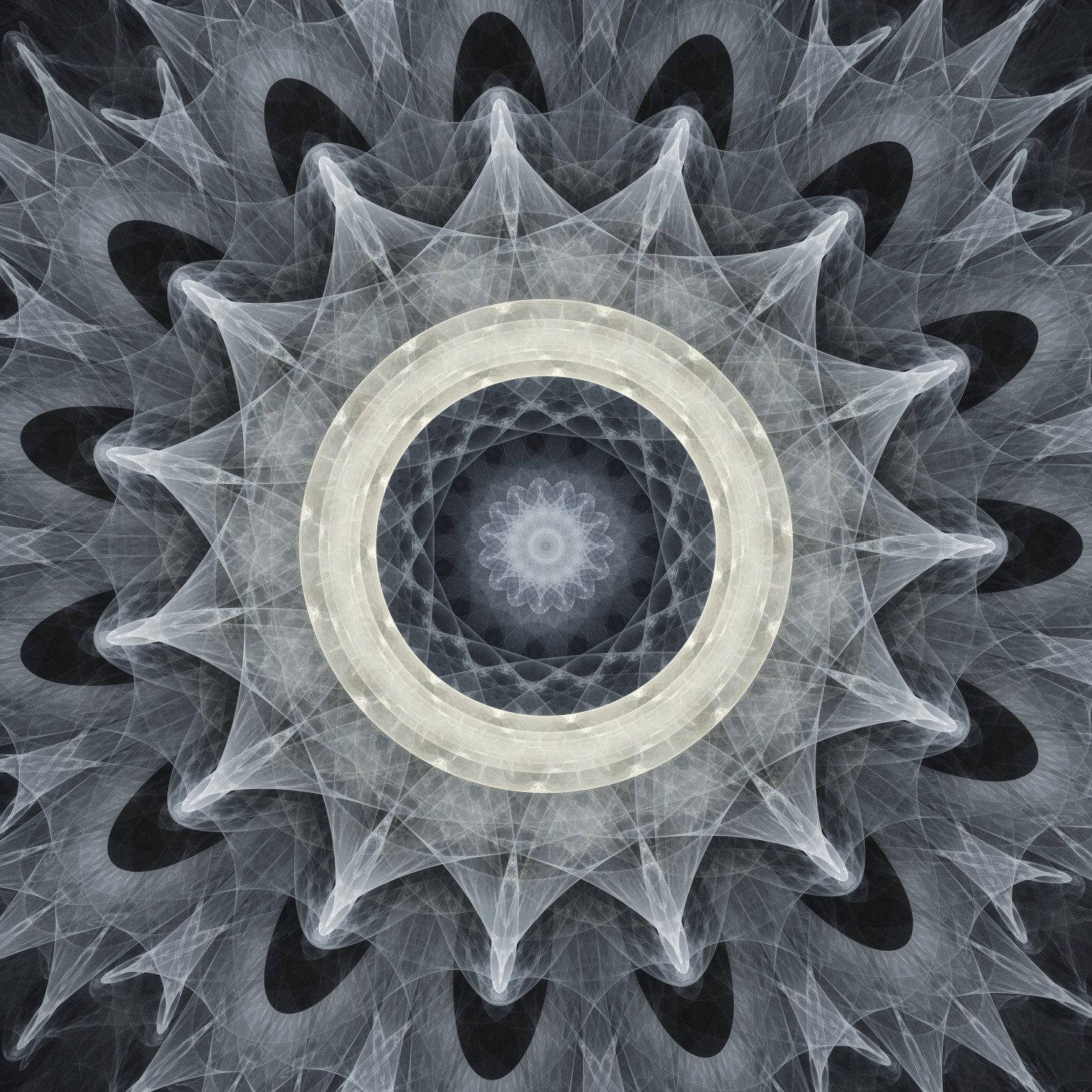
The Euclidean Plane is an idea. It does not exist as an experienced place. It is an area of width and length, but with no height at all, none. When I look at the artwork 'The Euclidean Plane', I am seeing light and the absence of light as an almost flat square surface. The photons that distinguish the visibly light and dark areas have height - these waves of light are around 400 to 700 nanometres, a nanometre being equal to one billionth of a metre: 0.000000001 m.
And yet, as I look at the artwork I think of it as both flat and as conveying the illusion of depth at one and the same time. I am drawn to the work as it is both pleasurable and curious. I ponder on the nature of a flat two dimensional plane. I gaze at the flowing arcs in search of pattern and form. I am in awe as the beauty of ideas and experience flood my mind.
ORIGINATOR · Mike de Sousa
ART FORM · Abstract Art
COMPLETED · 2016
Free to enjoy. Copyright maintained. Not to be used for ai or commercial gain.