
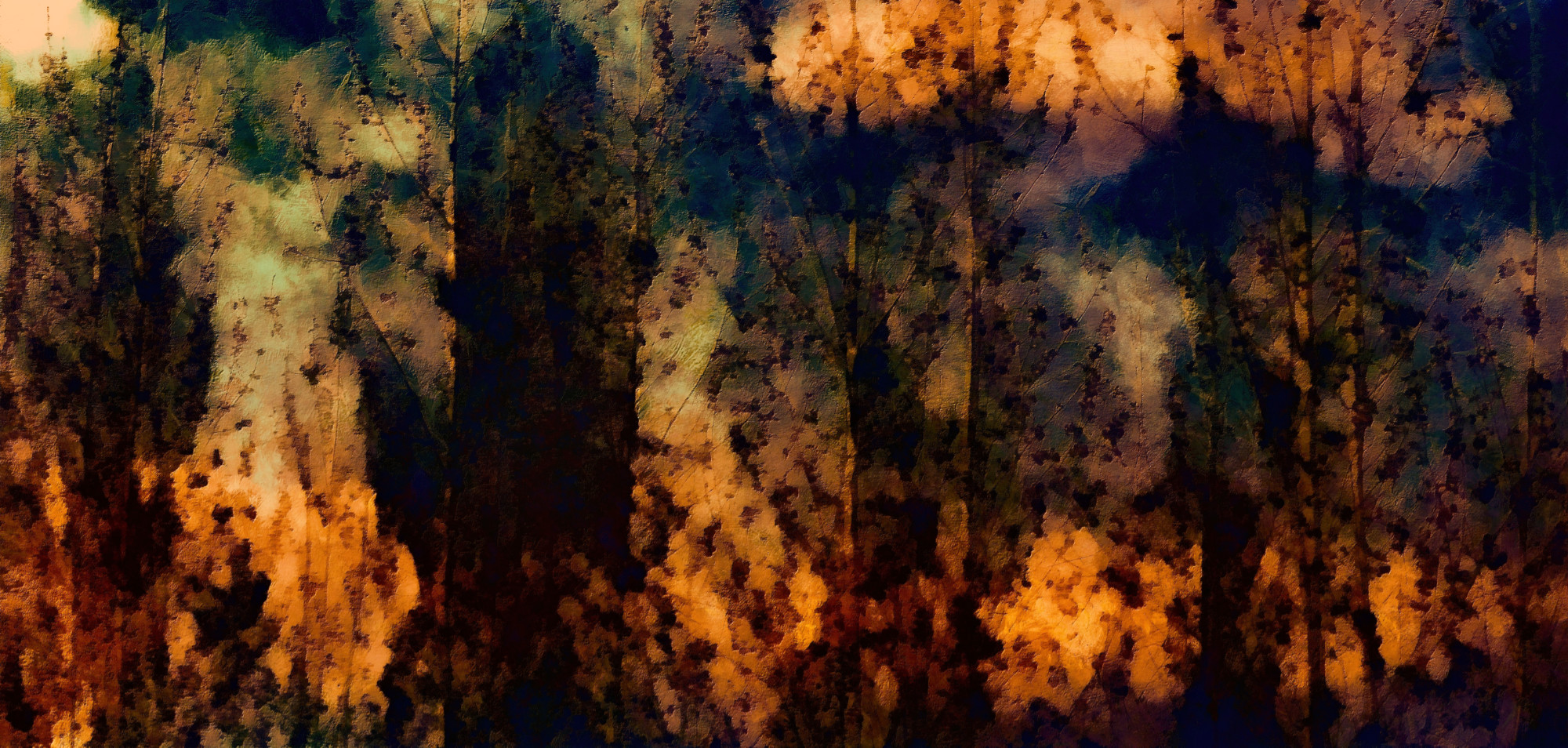
My eye explores the darkened deadly beauty of a land on fire. Saplings stand amid the flame.
Art can hold the eye for a moment, and perhaps in that short time something of the image stays within us, often buried, lasting, affecting.
This work began as I walked through a copse of saplings close to my home in Southern England. It was a clear, beautiful spring afternoon, and the last rust-red leaves of aspen clung to the slender branches like jewels in the low sunlight. Some of the images I created from that experience are lyrical and tender, but as news the following day of human suffering filled the air, a darker artwork took shape.
Among the many photos that appeared was one of an inconsolable father who held his still and precious child. I felt deeply uncomfortable as I paused on the image. I wondered whether permission was sought from this man to record such a profoundly personal and tragic moment, and whether I was in some way complicit by choosing to view this man with his motionless infant daughter. It is valuable to be informed, but my ceaseless consumption of news is at times troubling. My effort with 'The Fall of Light' is in part to fulfill a responsibility I felt as witness to that photo.
For me, the saplings in this work became a metaphor of the many young and innocent people who find themselves engulfed by the fire of war and conflict. The pull of form, colour and light reminds me of the unsettling appeal of the dramatic image. I am at once captivated and repelled.
Those things I see and hear remain within me and I have no choice but to recognize or ignore them.
The purpose of social art is to use creative expression as a means of persuasion that has the potential to affect change. While this change may be as modest as to cause pause, or as great as to save life, the artist has no say as to the impact of their work.
My eye explores the darkened deadly beauty of a land on fire...
ORIGINATOR · Mike de Sousa
ART FORM · Expressionist Art
COMPLETED · 2022
Free to enjoy. Copyright maintained. Not to be used for ai or commercial gain.